Dear Britain,
I am an immigrant. It’s not an easy label to wear and embrace. Especially today when people are able to spew their unfiltered thoughts onto social media walls. When politicians are using it to swing the sentiment of the people. When the hate is so open, so accessible and so prolific, I often find myself scouring social media comments only to find that one person who feels differently.
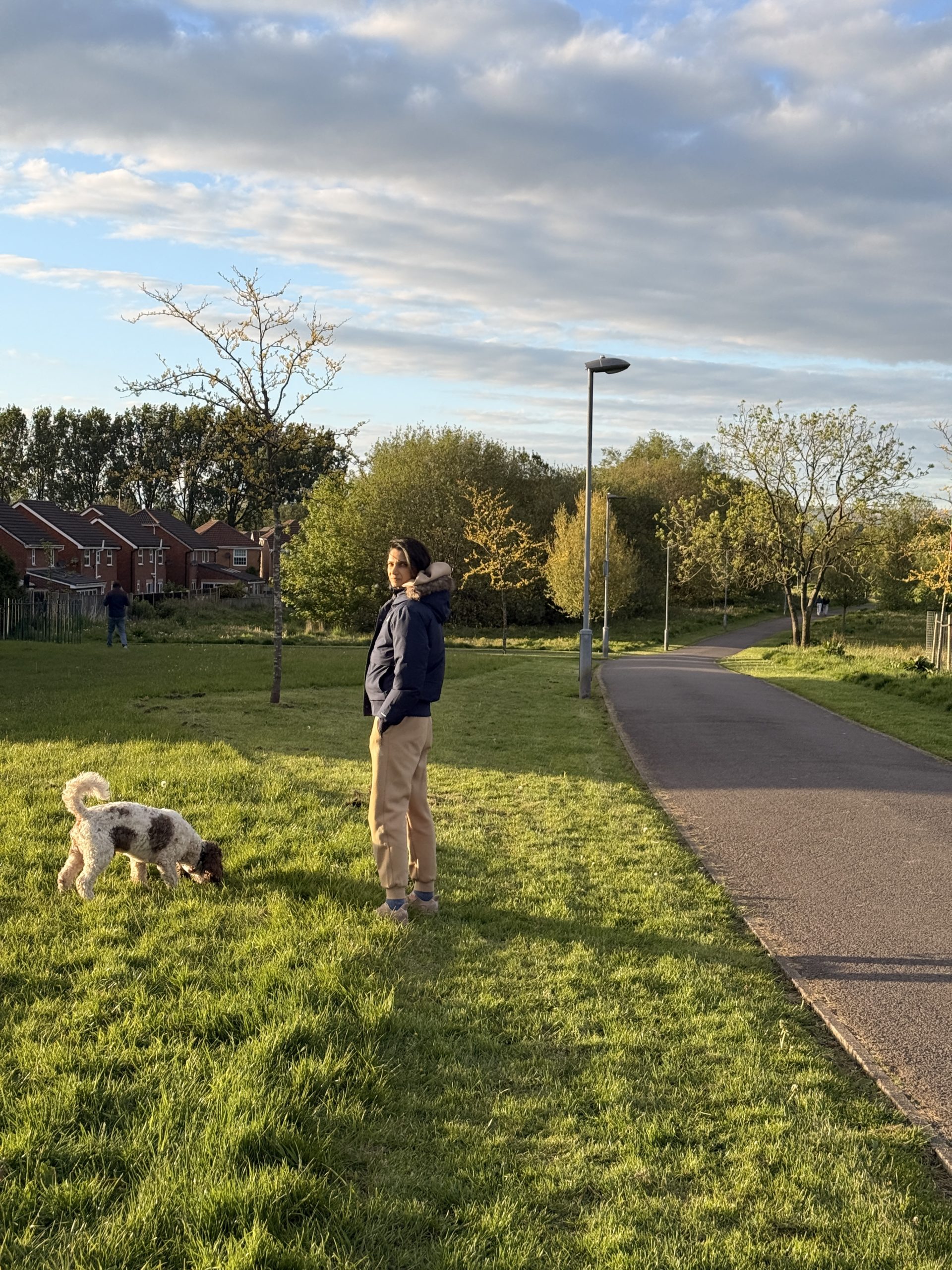
The husband and I live in a little town called Whitefield in North Manchester with our dog and two cats – Zorro the Cockapoo, Ziggy the Ragdoll and Zen the Silver Bengal. When we moved to the area in 2022, I did what I suspect most people do. I joined some local community groups on Facebook. They’ve been very useful. Alerting us to neighbourhood activities. Finding plumbers, gardeners, cleaners. Restaurant reviews and recommendations. Even reports of crime and incidents. Of late however, I’ve observed a trend of relating every antisocial report to immigration and race .

Doctors and engineers again?
Usual suspects?
Deport them!!
Amazing how colour is brought into the headlines when someone is white but not when they are any other colour!
Our town was also one of the first in Manchester to publicly display the national flags in 2025. They were all just magically there one morning, hanging from the lampposts in a neat array. I remember noticing them while on my morning run with Zorro. Other than finding the abruptness of their appearance a little odd, I quite liked the pops of blue and red, sometimes white and red, catching the morning sun purposefully. Having recently acquired my citizenship by naturalisation, I asked myself what it meant. How did I feel seeing them? There were no childhood memories for me other than seeing the flags in my geography textbooks in India. Other than linking it to the period of colonialism. The British Raj. No, this was a new memory for me. There was no deep association. The association, dear Britain, was much more with your land, your people, your textures and your moods, than your flag. And then I chanced upon an article linking their appearance to far-right extremism. I started seeing them more frequently, in people’s houses, hanging from balconies and plastered on windows. I asked myself how I felt then. I was unsure. I tried to connect all the people I met on the road with all the symbolism I saw. The friendly faces, the warm eyes. The smiles, the nods, the hellos. We were all bonded by routine. We crossed each other at the same time every day. In the gym early in the morning. Or when I was out running with Zorro. It was hard not to smile at my honey-hazel-eyed friend as he ran, long ears flopping and flying, pink tongue lolling. I could see even the sternest eyes softening as they saw him bounding along the pavement by my side. It felt like I knew them – these people whose daily paths crossed with mine. Like they knew me without knowing anything about me. So when I learnt about the deeper meaning behind the flags, I found myself wondering if some of them had flags hanging from the windows in their houses and what it meant to them. What was I to them? An outsider? An immigrant? Someone emblematic of a change they didn’t want?
On the subject of immigration, dear Britain, here’s an interesting fact. My father’s family was from a region in undivided India, now known as Bangladesh. When the few in power decided to divide people and draw imaginary lines on a piece of paper, his family fled as refugees to the land contained within the boundaries of the ‘new India’. I suppose that makes my father a second-generation immigrant to post-partition India. And me – aside from being a first-generation immigrant to the UK – also a third-generation immigrant to India. Religion is why my father’s family fled their land. As Hindus, they had no choice. They were stripped of their land, their titles, and their wealth. To survive, they sought refuge in what was quickly becoming ‘Hindu’ India.
Unlike my father’s family, my move to the UK was a conscious choice. Staying on in India would have been the easier, less disruptive option. It would be a natural continuation. Leveraging my three decades of insights on the Indian target market in my decade-long career in marketing. Experiencing the joys of having friends and family close by. Building a life with my husband in a land that wasn’t perfect, but was known and familiar. Yet, we pressed pause. And started a new script. One that began writing itself in January 2017. And is still being written today.
What does it mean then – to be Indian? To be British? To be British-Indian?
The passport I acquired in 2024 – the one that allows me to bypass the immigration queue in a UK airport – the queue I couldn’t previously ignore. The certificate that declares I am a naturalised British citizen. The forms I fill where I tick my ethnicity as British Asian or British Indian. Do these make me British-Indian?
Where are you from? No matter how many times I get asked the question, it always takes me by surprise. I always take a moment more than I should to respond. The heart blurts out first – from here! But the mind takes over. Does the question and the ensuing response make me less British?
Summers laden with the sweet, thick fragrance of Alphonso mangoes. Rain – reserved for a brief but vigorous season known as monsoon – heralded by petrichor wafting up through the cracks in the arid earth being sealed by water. Bengali, the language of my first babble as a toddler. Hindi, the second language I learnt, and English, the third. Do these childhood memories and experiences make me Indian?
I don’t have a neat label for my identity, dear Britain. My sense of belonging is derived from a state of constant osmosis between a veritable smorgasbord of experiences and memories from different lands, people and cultures. Unlike on a map, there are no clear boundaries here. It is complex and subtle, requiring nuance in thinking, understanding and hopefully, embracing.
I look at my long-eared friend napping by my side on the sofa, as I type this letter, dear Britain. His paws move vigorously in his sleep. A soft, excited sound escapes the land of his dreams and makes its way into our reality. I smile. He is probably bounding by my side on a typical morning in Whitefield. A familiar face is probably smiling and nodding at us. And my musings get taken over by a moment of clarity. A quiet realization descends. Whatever the passport says, whatever the tick box says, whatever the flags mean – this is simply, undeniably, home.